How to Generate Exam Test Papers with Answer Keys Online Free (BISE, CBSE & Global Boards Guide)
Executive Summary & Reference Guide
This authoritative guide provides step-by-step instructions, practical examples, and industry best practices for using our browser-based utility tools. Learn how to optimize your workflow securely without server uploads.
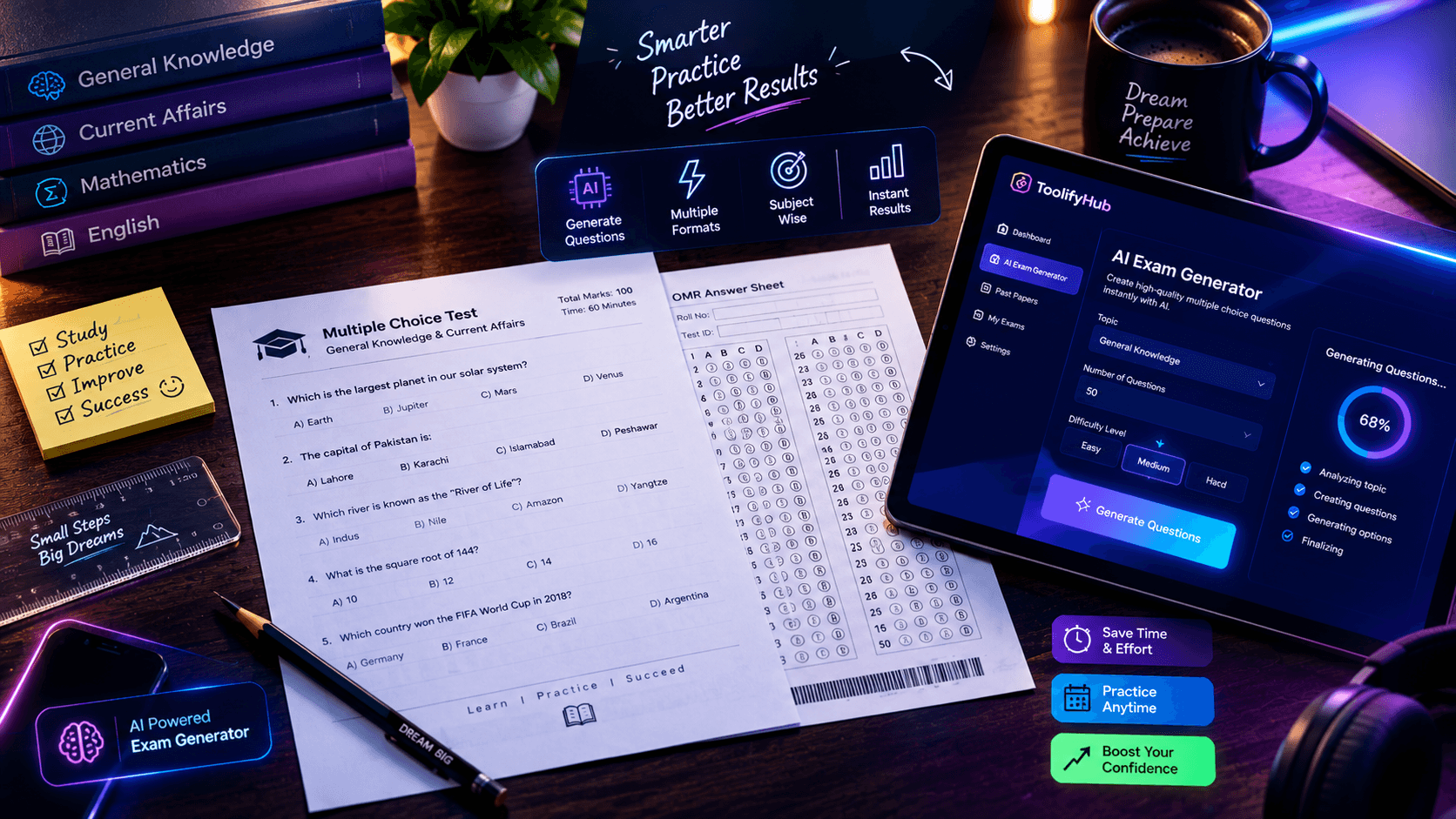
An AI Exam Paper Generator is an online educational assessment utility that ingests unstructured learning materials (such as textbook chapters, lecture slides, syllabus notes, or past papers) and automatically structures them into standardized examination papers complete with plausible distractors, verified answer keys, and cognitive skill classifications. Instead of spending 45 to 60 minutes manually formatting tables in Microsoft Word or InPage Urdu, educators can generate curriculum-aligned classroom tests, vector OMR bubble sheets, and instant digital quiz links in under 60 seconds.
Ready to generate your classroom test right now?
Access ToolifyHub's free, zero-login AI MCQ & Test Generator with Urdu Nastaliq, printable A4 layouts, and OMR sheets.
Executive Takeaways for Educators
- Zero Formatting Friction: Generates ready-to-print A4 classroom exam papers with official school headers and roll number boxes.
- Dual Medium Support: Renders authentic right-to-left Urdu Nastaliq typography alongside standard English options.
- Bloom's Taxonomy Mapping: Balances recall questions with problem-solving and analytical reasoning items.
- Printable OMR Sheets: Auto-formats vector bubble answer sheets matching exact item counts for rapid evaluation.
- 100% Free Access: No paywalls, subscription tiers, or student sign-ups required.
- WhatsApp Quiz Links: Instant 36-character mobile links for remote practice and auto-grading.
The 45-Minute Formatting Bottleneck: Why Manual Test Setting Drains Teaching Energy
For decades, secondary and higher secondary educators have faced a repetitive administrative chore: creating chapter-wise tests and midterm assessments in word processing applications. Drafting a 25-question multiple-choice exam paper in Microsoft Word or legacy Urdu InPage software consumes an average of 45 to 60 minutes per test.
Teachers do not spend this time evaluating pedagogy; they spend it battling typographic friction:
Aligning four options (A, B, C, D) horizontally across columns breaks whenever an option spans two lines, ruining A4 margin geometry.
Copying Urdu text between InPage and Word corrupts Nastaliq ligatures, causing question marks to flip and text boxes to overlap.
Rearranging questions manually frequently decouples question numbers from the separate answer key sheet, leading to grading disputes.
Automated assessment generation eliminates manual typesetting by decomposing syllabus material directly into validated question items, complete with paired answer keys and printable layout formatting.
Curriculum Compatibility Matrix: How Assessment Frameworks Differ Across Boards
A generic test maker that treats all multiple-choice questions identically fails in real classrooms because different educational boards enforce distinct assessment standards. The table below details how modern test generation handles different curriculum requirements:
| Curriculum / Board | Key Assessment Characteristics | Language & Format | ToolifyHub Optimization |
|---|---|---|---|
| BISE Pakistan (Punjab, Federal FBISE, Sindh, KPK, Balochistan) | SLO-based assessment (Student Learning Outcomes), chapter-wise pairing schemes, 20% knowledge / 50% understanding / 30% application ratio. | Dual Medium (English / Urdu Nastaliq RTL) | Native RTL Nastaliq fonts, Matric & Intermediate past paper patterns, printable A4 school layout. |
| CBSE & ICSE (India - Classes 9 to 12) | Competency-based questions, Assertion-Reasoning pairs, case-study contextual evaluation. | English / Hindi | Two-statement Assertion & Reason templates, higher-order thinking skill (HOTS) stems. |
| Cambridge CAIE (O Level / IGCSE / A Level) | Rigid command words (State, Explain, Calculate, Deduce), zero "all of the above" crutches, highly plausible distractors. | British English | Strict 4-option symmetry, distractors derived from common student misconceptions. |
| US AP & SAT (College Board Standards) | Context-rich stimulus passages, quantitative data interpretation, primary source excerpts. | American English | Stimulus-based question clusters with detailed methodological justifications. |
Step-by-Step Walkthrough: From Raw Text or Photo to Classroom Paper in 60 Seconds
Generating an assessment on ToolifyHub requires no account setup or software installation. Follow this 4-step workflow:
Select Your Input Mode
You can paste raw text from curriculum notes, upload a textbook chapter PDF, or capture a photo of a textbook page with your smartphone. When an image is provided, client-side OCR transcribes the text locally without uploading your private documents to external servers.
Configure Board Pattern & Target Depth
Select your target curriculum pattern (BISE Pakistani boards, CBSE, Cambridge O/A Levels, or Custom). Choose the question count (5 to 50 questions), language mode (English, Urdu Nastaliq, or Bilingual), and difficulty rating.
Review Items & Pedagogical Rationales
Inspect the generated stems and distractors. Every question includes a verified answer key and an explanation clarifying why the correct option holds and why distractors are invalid. You can edit any question or shuffle choices with a single tap.
Print A4 Exam Paper or Share Digital Link
Choose your distribution channel:
- Physical Classroom: Click "Print A4 Exam" to format an official printable sheet with your school name, exam title, and roll number boxes, plus an attached vector OMR bubble sheet.
- Remote Digital Testing: Copy the 36-character native URL (
toolifyhub.tools/test/[id]) and broadcast it directly to student WhatsApp or Telegram study groups. Students complete the timed test on their phones with instant score feedback.
The Science of High-Yield Distractors & Bloom's Taxonomy in Assessment Design
The difference between an amateur test and an official board exam lies in the quality of the incorrect choices (distractors). Weak tests include obviously wrong options that allow students to guess the correct answer through simple elimination.
Professional exam authoring applies Bloom's Revised Taxonomy to distribute cognitive demand across six sequential stages:
Lower-Order Cognitive Skills (LOTS)
- Remembering (Recall): Retrieving relevant terminology, constants, and basic definitions (e.g., "What is the SI unit of electric flux?").
- Understanding (Comprehension): Explaining ideas, classifying phenomena, and summarizing core processes in original phrasing.
Higher-Order Cognitive Skills (HOTS)
- Applying (Problem-Solving): Implementing rules or mathematical formulas in unfamiliar quantitative problems.
- Analyzing (Critical Thinking): Distinguishing between facts and inferences, breaking down complex mechanisms, and identifying systemic causes.
The Mathematical Penalty for Random Guessing
In competitive entrance testing (such as MDCAT, ECAT, SAT, and JEE), raw scores are calibrated using negative marking formulas to penalize random guessing:
Where N represents the number of choices per question. In a standard 4-option test (N = 4), every incorrect answer deducts 1/3 of a mark. If distractors are not equally plausible, the effective value of N drops to 2 or 3, artificially inflating unearned scores. ToolifyHub engineers distractors by calculating common calculation slips (such as sign inversions or dropped units) to ensure authentic assessment fidelity.
Physical A4 Paper vs Digital Mobile Quiz Delivery
While Western educational startups assume that every student has an individual laptop or tablet in class, the operational reality across public schools and private academies in South Asia and emerging markets is different: 85% of summative testing occurs on physical printed paper.
Printable Classroom Mode (A4 + OMR)
Generates a print-ready A4 document formatted with institutional branding fields: school name, session, exam duration, total marks, and student roll number boxes. Options are arranged in symmetrical double columns to minimize paper usage. An aligned vector OMR bubble response sheet is attached, allowing fast grading.
Interactive WhatsApp Quiz Mode
Generates a clean 36-character URL (toolifyhub.tools/test/[id]) designed for instant smartphone access. Students do not need to download an application or create accounts. They complete the test under a live countdown timer, receive real-time answer rationales, and can submit their score certificates back to the teacher with a single tap.
5 Critical Item-Writing Mistakes Educators Must Avoid
When drafting or reviewing test papers, watch out for these five common item-writing errors that compromise assessment validity:
Frequently Asked Questions (Educator Guide)
Q1:Can I generate test papers in Urdu Nastaliq script?
Yes. The generator provides native right-to-left Urdu Nastaliq rendering for Pakistani boards (BISE Lahore, Rawalpindi, FBISE, Multan, Sindh). You can generate pure Urdu papers or bilingual side-by-side English and Urdu papers.
Q2:Does the generator create matching answer keys and explanations?
Yes. Every generated test includes a teacher verification key with correct options and step-by-step rationales. When exporting to printable A4 PDF, the answer key can be placed on a separate final page for teacher grading.
Q3:Can I generate questions directly from a textbook photo or PDF?
Yes. You can upload textbook PDFs, lecture slide decks, or snap mobile photos of textbook pages. The built-in client-side OCR extracts text locally and constructs questions strictly grounded in your provided material.
Q4:Does it support Bloom's Taxonomy cognitive levels?
Yes. You can customize the distribution between Knowledge (Remembering), Comprehension (Understanding), Application (Problem Solving), and Analysis (Critical Thinking) to match board requirements.
Q5:How do printable OMR bubble response sheets work?
The tool automatically generates an aligned, printable A4 vector OMR bubble response sheet matching the exact number of questions. Students fill bubbles with lead pencil or black pen for rapid manual grading or optical scanning.
Q6:Is there any cost, credit card prompt, or monthly quota?
No. ToolifyHub provides 100% free assessment generation without subscription walls, mandatory user accounts, or watermarks on your printed classroom tests.
Q7:Can students take the test online without signing up?
Yes. Teachers can copy a lightweight 36-character native test link (toolifyhub.tools/test/[id]) and paste it into student WhatsApp groups. Students open the link instantly, take the timed test on mobile or desktop, and submit scores without creating accounts.
Q8:Which educational boards and curricula are supported?
The system supports Pakistani BISE (Matric and Intermediate 9th, 10th, 11th, 12th), Indian CBSE and ICSE boards, Cambridge Assessment International Education (CAIE O Levels and A Levels), and US AP and SAT assessment styles.
Q9:How do I add my school logo and custom examination header?
In the printable preview panel, you can type your school or academy name, exam title (e.g., Midterm Examination 2026), subject, class, allowed time, maximum marks, and candidate roll number blanks before printing or saving to PDF.
Q10:Does the tool retain or train on my uploaded test questions?
No. Text extraction and document parsing execute in-browser or through stateless, encrypted model pipelines with zero data logging. Your custom proprietary notes and draft exam items are never stored on remote servers.
Explore Related Academic & Productivity Utilities on ToolifyHub
Complement your assessment workflow with our suite of free, client-side academic tools:

Ali Gohar
Founder of ToolifyHub.tools
I built ToolifyHub.tools after getting frustrated with expensive, watermarked, and signup-required tools. Based in Larkana, Pakistan. I test every tool personally before publishing.
Try Related Tools Free
Professional utilities to help you get things done faster.