How Much Tax on a Rs 100,000 Salary in Pakistan? Worked Examples (2026-27)
Executive Summary & Reference Guide
Perform accurate financial calculations for interest, loans, bills, and discount percentages. This tutorial reviews weighted ratios and amortization mathematics to help you project monthly expenses.
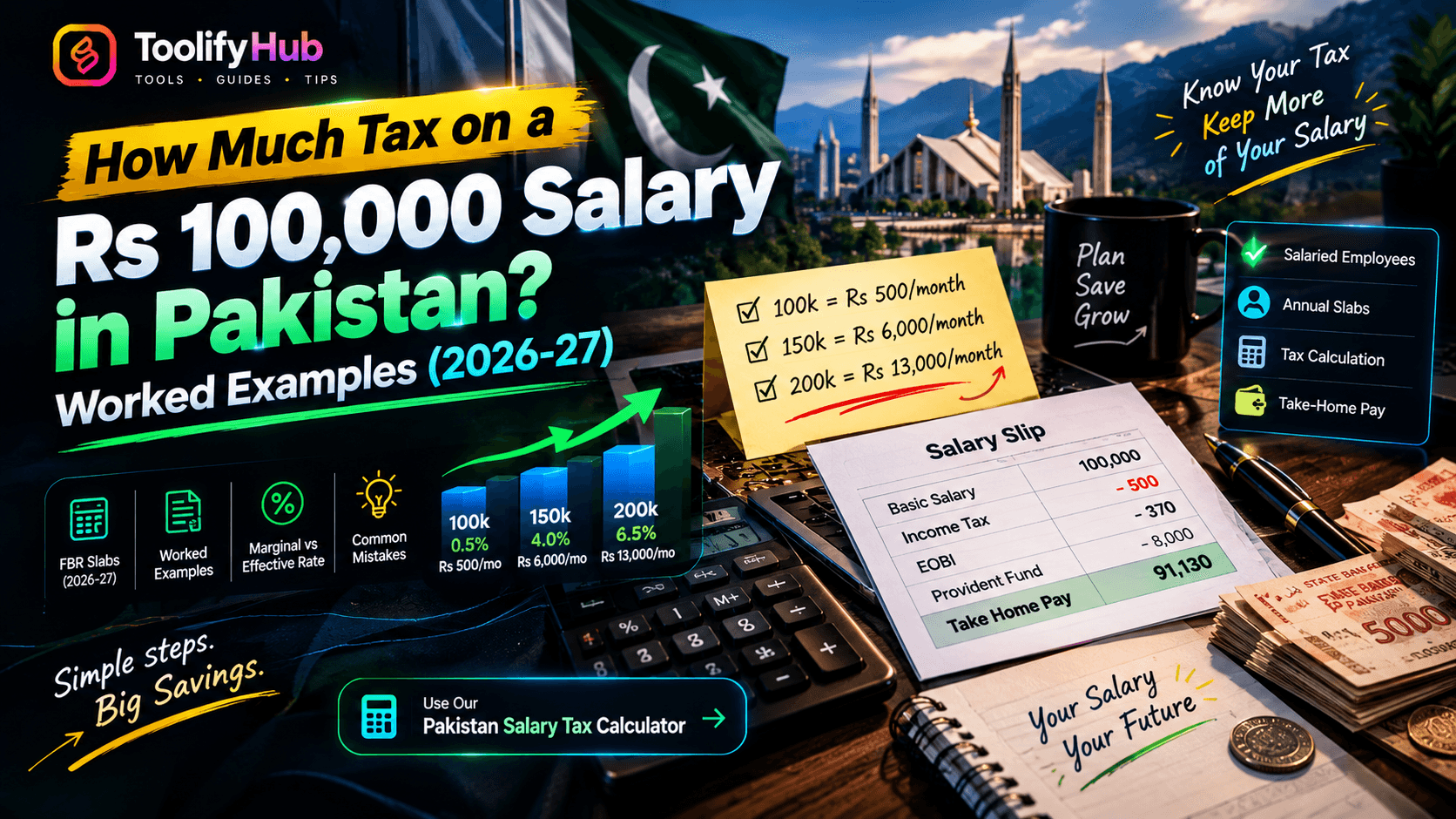
The short answer: on a Rs 100,000 monthly salary, a salaried employee in Pakistan pays Rs 500 per month in income tax under the 2026-27 slabs - a total of Rs 6,000 a year, or just 0.5% of salary. Most people guessing their tax land much higher, because they apply the slab rate to their whole salary. That is not how Pakistan's progressive tax works.
Here are the exact numbers first, then the step-by-step maths:
| Monthly salary | Annual income | Annual tax | Monthly deduction | Effective rate |
|---|---|---|---|---|
| Rs 100,000 | Rs 1,200,000 | Rs 6,000 | Rs 500 | 0.5% |
| Rs 150,000 | Rs 1,800,000 | Rs 72,000 | Rs 6,000 | 4.0% |
| Rs 200,000 | Rs 2,400,000 | Rs 156,000 | Rs 13,000 | 6.5% |
| Rs 300,000 | Rs 3,600,000 | Rs 416,000 | Rs 34,667 | 11.6% |
| Rs 500,000 | Rs 6,000,000 | Rs 1,104,000 | Rs 92,000 | 18.4% |
Calculate your exact take-home pay instantly
Want your exact figure without doing the maths? Run it through our free Pakistan Salary Tax Calculator or view our dedicated Tax on Rs 100,000 Salary Calculator - monthly and annual, instant.
The 2026-27 Salaried Tax Slabs (FBR)
These are the official salaried-individual slabs for FY 2026-27 (Finance Act 2026), effective from July 2026. Only income above each threshold is taxed at that slab's rate - never your whole salary:
| Annual taxable salary | Tax |
|---|---|
| Up to Rs 600,000 | 0% (tax-free) |
| Rs 600,001 - 1,200,000 | 1% of amount above Rs 600,000 |
| Rs 1,200,001 - 2,200,000 | Rs 6,000 + 11% of amount above Rs 1,200,000 |
| Rs 2,200,001 - 3,200,000 | Rs 116,000 + 20% of amount above Rs 2,200,000 |
| Rs 3,200,001 - 4,100,000 | Rs 316,000 + 25% of amount above Rs 3,200,000 |
| Rs 4,100,001 - 5,600,000 | Rs 541,000 + 29% of amount above Rs 4,100,000 |
| Rs 5,600,001 - 7,000,000 | Rs 976,000 + 32% of amount above Rs 5,600,000 |
| Above Rs 7,000,000 | Rs 1,424,000 + 35% of amount above Rs 7,000,000 |
The relief budget of 2026 also scrapped the old 9% surcharge on high salaried incomes - gone from your July 2026 payslip onward.
Worked Examples: The Maths, Step by Step
The formula your employer uses is the same for everyone: annualise your salary (x12), find your slab, compute the annual tax, divide by 12.
Example 1: Rs 100,000/month
- Annual income: 100,000 × 12 = Rs 1,200,000
- Slab: 600,001 - 1,200,000 → 1% of amount above 600,000
- Tax: 1% × (1,200,000 − 600,000) = Rs 6,000/year
- Monthly deduction: 6,000 ÷ 12 = Rs 500
- Take-home: Rs 99,500 (before EOBI/provident fund)
Notice: the first Rs 600,000 of salary is completely tax-free. Only the remaining 600,000 is touched at 1%. This is why the bill is so small - and why "100k salary par 1% tax" guesses of Rs 1,000 are wrong. You never pay 1% on the whole 1.2 million.
Example 2: Rs 150,000/month
- Annual income: 150,000 × 12 = Rs 1,800,000
- Slab: 1,200,001 - 2,200,000 → Rs 6,000 + 11% of amount above 1,200,000
- Tax: 6,000 + 11% × (1,800,000 − 1,200,000) = 6,000 + 66,000 = Rs 72,000/year
- Monthly deduction: Rs 6,000
- Take-home: Rs 144,000 (before EOBI/provident fund)
The jump from 100k to 150k feels bigger than it is: half the salary increase falls in the 1% bracket, half in the 11% bracket. Your marginal rate is 11% but your effective rate is only 4%.
Example 3: Rs 200,000/month
- Annual income: 200,000 × 12 = Rs 2,400,000
- Slab: 2,200,001 - 3,200,000 → Rs 116,000 + 20% of amount above 2,200,000
- Tax: 116,000 + 20% × (2,400,000 − 2,200,000) = 116,000 + 40,000 = Rs 156,000/year
- Monthly deduction: Rs 13,000
- Take-home: Rs 187,000 (before EOBI/provident fund)
Marginal Rate vs Effective Rate: Why It Matters
Your marginal rate is the slab you sit in - the rate on your next rupee. Your effective rate is total tax ÷ total salary - what you actually feel. Look at the 200k example: the marginal rate is 20%, but the effective rate is just 6.5%. Almost two-thirds of the 2.4 million is taxed at 11% or less (or nothing at all).
This is the single most misunderstood idea in Pakistan salary tax. Whenever you hear "tax rate badh gayi," check which one people mean - for the vast majority of salaried employees, the effective rate is a fraction of the headline number.
3 Mistakes That Give You the Wrong Number
- Applying the rate to your monthly salary. A 100k salary does not pay 1% of 100,000 (Rs 1,000). You must annualise first: the slab works on Rs 1,200,000/year, and only the slice above Rs 600,000 is taxed. Correct answer: Rs 500/month.
- Taxing the whole salary at your slab rate. A 200k earner in the 20% bracket does not pay 20% of 2.4 million (Rs 480,000). Each slice of income is taxed at its own bracket. Correct answer: Rs 156,000/year.
- Forgetting bonuses and annualisation. Your employer annualises: annual bonus, arrears and taxable allowances all go into the year's figure before the slab is applied. A "100k" salary with a yearly bonus is taxed on more than 1.2 million.
The full method is covered in our guide on how income tax on salary is calculated in Pakistan (2026-27).
What Else Comes Out of Your Salary
Income tax is not the only deduction on a payslip. EOBI (around Rs 370/month employee share) and provident fund contributions (typically 8-10% of basic salary, if your employer offers one) are deducted separately from salary tax - provident fund is generally exempt from income tax. So the Rs 99,500 take-home on a 100k salary shrinks a little further. We will cover every non-tax deduction line by line in a separate post.
How Your Employer Deducts It
Your company does not guess. Each month it annualises your salary, computes the yearly tax on the slab above, divides by 12, and withholds that amount - appearing on your payslip as "Income Tax" or "Withholding Tax (WHT) u/s 149." That is why a salary hike in March quietly changes your monthly deduction: the annualised figure crosses a slab boundary.
Frequently Asked Questions
Is salary up to Rs 50,000/month tax-free in Pakistan?
Yes. Annual income up to Rs 600,000 is exempt, so a 50k/month salary with no other taxable income pays zero income tax in 2026-27.
What if my salary changes mid-year?
Your employer re-annualises at the new rate. If you jump from 100k to 150k in January, withholding rises from around Rs 500 to around Rs 6,000/month for the remaining months.
Do freelancers pay tax at these same slabs?
Not exactly: freelancers and self-employed professionals are taxed under different schedules, and PSEB-registered exporters of IT services have had special low-rate regimes. That is a whole separate calculation, which we will cover in our freelancer tax guide.
Does the tax get deducted if my income is under Rs 600,000?
No income tax: but you will still see EOBI and possibly provident fund deductions, which are not taxes.
Which tax year am I paying in right now?
FY 2026-27 (Tax Year 2027) runs July 2026 to June 2027: that is what your current monthly deductions follow. Returns for this year are filed by 30 September 2027.
Check Your Exact Number
These examples cover the most common salaries, but allowances, bonuses and provident fund make everyone slightly different. Plug your own figure into our free Pakistan Salary Tax Calculator and get your monthly deduction and take-home pay in seconds - no signup, runs entirely in your browser.
Related Pakistan Tax Calculators & Guides
Explore our complete suite of verified, 100% private financial tools built specifically for Pakistan:

Ali Gohar
Founder of ToolifyHub.tools
I built ToolifyHub.tools after getting frustrated with expensive, watermarked, and signup-required tools. Based in Larkana, Pakistan. I test every tool personally before publishing.
Try Related Tools Free
Professional utilities to help you get things done faster.