Why Is My Electricity Bill So High in Pakistan? The 200-Unit Trap, Explained (2026 Tariff)
Executive Summary & Reference Guide
Perform accurate financial calculations for interest, loans, bills, and discount percentages. This tutorial reviews weighted ratios and amortization mathematics to help you project monthly expenses.
Every summer, the same scene plays out in homes across Pakistan. The bijli ka bill arrives, the amount is double last month's, and everyone blames the meter. But in most cases the meter is fine. The real culprit is a rule most people have never heard of: the protected vs unprotected consumer system - and a slab structure where one single extra unit can add over a thousand rupees to your bill.
Estimate your bill before it arrives
Check your exact slab, protected status, and hidden surcharges with our free Electricity Bill Calculator - updated for 2026 NEPRA tariffs across LESCO, IESCO, MEPCO, FESCO, and K-Electric.
In this guide you will learn how Pakistan's domestic electricity tariff actually works in 2026, see a worked example at 200, 201 and 300 units, understand every extra charge printed on your bill, and find out how to check your own bill before it arrives.
Protected vs Unprotected: The Status That Decides Your Bill
NEPRA divides domestic consumers into categories based on how much electricity they use:
- Lifeline consumers use up to 100 units a month and pay the lowest rates.
- Protected consumers have used 200 units or less in each of the last six months. They get heavily subsidised rates.
- Unprotected (non-protected) consumers crossed 200 units in at least one of the last six months. They lose the subsidy - and pay roughly double the per-unit rate.
Here is the part that hurts: if you cross 200 units even once, you become unprotected, and you stay unprotected for the following months until you complete six consecutive months at or under 200 units again. One careless month with guests, a wedding, or extra AC use can raise your bills for half a year.
There is a second trap. Protected consumers pay slab rates progressively - the first 100 units at one rate, the next 100 at a slightly higher rate. Unprotected consumers are charged differently: the slab rate of the highest slab you reach applies to every unit you consumed. That is why bills do not rise gently - they jump off a cliff.
NEPRA Domestic Slab Rates 2026
These are the current domestic rates under the NEPRA tariff (S.R.O. 279(I)/2026), before fixed charges, adjustments and taxes:
| Category | Units | Rate (Rs per unit) |
|---|---|---|
| Lifeline | 1-50 | 3.95 |
| Lifeline | 51-100 | 7.74 |
| Protected | 1-100 | 10.54 |
| Protected | 101-200 | 13.01 |
| Unprotected | 1-100 | 22.44 |
| Unprotected | 101-200 | 28.91 |
| Unprotected | 201-300 | 33.10 |
| Unprotected | 301-400 | 37.99 |
| Unprotected | 401-500 | 40.20 |
| Unprotected | 501-600 | 41.62 |
| Unprotected | 601-700 | 42.76 |
| Unprotected | Above 700 | 47.69 |
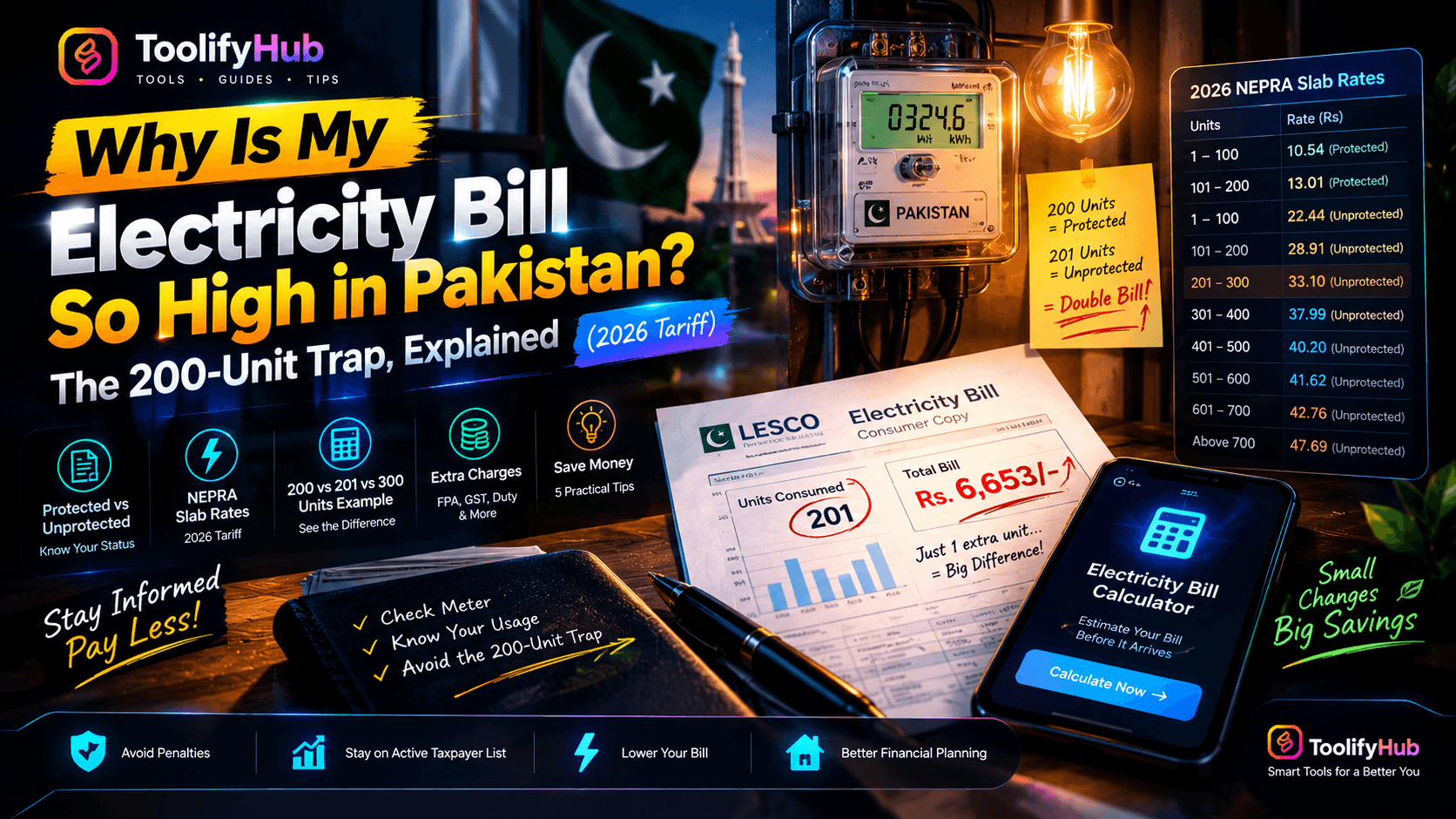
Look at the jump: a protected consumer pays Rs 13.01 for their 200th unit. An unprotected consumer pays Rs 28.91 for the same unit - and if they reach 201 units, all of their units are billed at Rs 33.10.
A Worked Example: 200 vs 201 vs 300 Units
Let's do the maths on energy charges alone (before fixed charges, fuel adjustment and taxes):
- 200 units, protected: (100 × Rs 10.54) + (100 × Rs 13.01) = Rs 2,355
- 201 units, unprotected: 201 × Rs 33.10 = Rs 6,653
- 300 units, unprotected: 300 × Rs 33.10 = Rs 9,930 in energy charges - around Rs 13,267 all-in for a typical LESCO bill once the fixed charge, fuel adjustment, quarterly adjustment, duty, GST and TV fee are added.
Read the first two lines again. Using one extra unit - going from 200 to 201 - can add more than Rs 4,000 in energy charges alone, because you lose protected status and every unit is re-priced at the higher slab rate. This is the 200-unit trap, and it is the single most common reason Pakistani households see a "suddenly doubled" bill.
Want to test your own numbers? Enter your units into our free Electricity Bill Calculator and see your estimated bill instantly - it supports LESCO, FESCO, MEPCO, IESCO and other WAPDA distribution companies.
The Extra Charges Nobody Explains
Your per-unit charges are only part of the bill. These lines push the total higher:
- Fixed charge: based on your sanctioned load (for example, around Rs 350 for a 1 kW connection). You pay it even if you use very little electricity.
- Fuel Price Adjustment (FPA): a per-unit charge that changes every month with fuel costs (around Rs 2.06 per unit in mid-2026 bills). This is why two identical months can produce different bills.
- Quarterly adjustment: another small per-unit amount, revised every three months.
- Electricity duty: a provincial tax of about 1.5%.
- GST: 18% sales tax applied on top.
- TV fee: a flat Rs 35 for domestic consumers.
- Income tax for non-filers: if your bill is Rs 25,000 or more and you are not on the FBR Active Taxpayer List, an extra 7.5% income tax is added. (Not sure about your tax status or salary tax? Try our Pakistan Tax Calculator.)
Add these up and your effective cost per unit is far above the headline slab rate - a 300-unit unprotected bill works out to roughly Rs 44 per unit all-in.
The Hidden Meter Reading Window Trap
Many consumers who carefully monitor their meters still end up crossing 200 units due to billing calendar variations. While a standard billing cycle should be 30 days, DISCO meter readers sometimes take readings after 32, 33, or 35 days.
Those extra three to five days of consumption can easily turn a compliant 195-unit month into 215 units, stripping away your protected status for the next six months. Check the "Reading Date" and "Billing Period" on your bill every month. If the cycle exceeds 30 days and knocks you into an unprotected tier, you have the right to lodge a complaint with your DISCO's customer service center or NEPRA's consumer portal.
Appliance Energy Consumption: How 200 Units Burn
To defend your protected status, it helps to understand what 200 units actually look like in real appliance runtimes:
- 1.5-Ton Inverter AC (26°C): Consumes ~0.8 to 1.2 units per hour. Running 8 hours nightly uses 200 to 280 units a month by itself.
- 1.5-Ton Non-Inverter AC: Consumes ~1.5 to 1.8 units per hour. Running 8 hours nightly uses 360 to 430 units a month.
- 1 HP Water Pump: Consumes ~0.75 units per hour. Running 1 hour daily uses ~22.5 units a month.
- Refrigerator (Medium Frost-Free): Consumes ~1.5 to 2.5 units per day (~45 to 75 units a month).
- Ceiling Fan (Standard Induction): Consumes ~75W (~0.6 units per 8 hours). Running 4 fans all day uses ~70 units a month.
5 Practical Ways to Bring Your Bill Down
- Defend the 200-unit line. Check your meter reading in the last week of the billing cycle. If you are close to 200, cut usage for a few days - staying protected is worth thousands of rupees over the next six months.
- Know your AC's appetite. A 1.5-ton non-inverter AC uses roughly 12 units in an 8-hour night. Two ACs running all night can push a home past 200 units on their own. Raising the thermostat to 26-27°C and using the timer makes a real difference.
- Watch the slab cliff, not just the total. For unprotected consumers, finishing the month at 299 units instead of 301 can save over Rs 1,300, because the lower slab rate applies to every unit.
- Spread heavy loads. Iron, washing machine, water motor and microwave running in the same days add up fast near month-end. Stagger them.
- Estimate before the bill arrives. A surprise bill cannot be managed; an expected one can. Run your meter reading through the Electricity Bill Calculator mid-month so you have time to adjust. For the full step-by-step method, see our guide on how to calculate your electricity bill online.
Frequently asked questions
What is a protected consumer in Pakistan?
A protected consumer is a residential user who has consumed 200 units or less in each of the previous six consecutive months. Protected consumers receive government-subsidized slab rates (Rs 10.54 to 13.01 per unit) instead of the standard unprotected rates.
Why did my bill double when I only used a few extra units?
Crossing 200 units immediately strips away your protected status. For unprotected consumers, the higher slab rate applies without the protected subsidy, and base rates jump from Rs 13.01 to Rs 28.91 or Rs 33.10 across the entire consumption tier, dramatically increasing both energy costs and proportional taxes.
How long does it take to get back into the protected category?
You must stay at or below 200 units for six consecutive months. If you consume 201 units in even a single month during summer, you remain in the unprotected category for the next six months until you complete six full qualifying billing cycles.
What is FPA in an electricity bill?
FPA (Fuel Price Adjustment) is a monthly per-unit charge notified by NEPRA that reflects the actual variation in fuel costs used to generate electricity compared to reference tariffs. Because generation fuel costs fluctuate, FPA varies month to month with a one-to-two-month billing lag.
Do non-filers pay extra tax on electricity bills?
Yes. Under Section 235 of the Income Tax Ordinance, non-filers pay an additional 7.5% advance income tax on domestic electricity bills of Rs 25,000 or more. Active filers on the FBR Active Taxpayer List (ATL) are exempt from this surcharge.
How can I check my electricity bill before it arrives?
Record your current meter reading, subtract the previous reading printed on your last bill to find your units consumed, and enter that number into our free Electricity Bill Calculator. It calculates your exact bill with NEPRA slabs, fixed charges, FPA, and all applicable taxes.
Related guides and tools
Plan and audit your utility bills with our free specialized calculation tools:
- Electricity Bill Calculator - Calculate domestic, commercial, and industrial electricity bills across all Pakistan DISCOs.
- How to Calculate Electricity Bill Online - Full breakdown of WAPDA tariff slabs, FPA surcharges, and appliance energy formulas.
- Tax Calculator Pakistan - Calculate your income tax and verify your filer status to avoid non-filer surcharges.
Rates in this article are based on the NEPRA domestic tariff notified for 2026 (S.R.O. 279(I)/2026). Fuel and quarterly adjustments change monthly, so treat calculator results as close estimates rather than exact bills. Last updated: October 2026.

Ali Gohar
Founder of ToolifyHub.tools
I built ToolifyHub.tools after getting frustrated with expensive, watermarked, and signup-required tools. Based in Larkana, Pakistan. I test every tool personally before publishing.
Try Related Tools Free
Professional utilities to help you get things done faster.