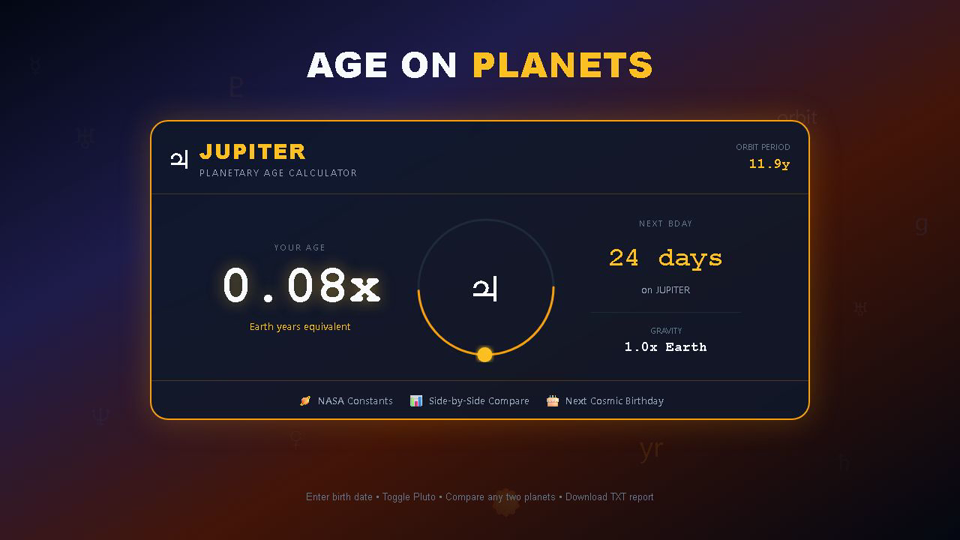
Why You Actually Need an Age on Other Planets
Discover how old you would be and what you would weigh across the solar system. This educational astrophysics tool calculates your cosmic age and planetary gravitational weight on Mercury, Venus, Mars, Jupiter, Saturn, Uranus, Neptune, and Pluto based on each planet's orbital revolution around the Sun and local surface gravity.
Each celestial body possesses a distinct sidereal orbital period (the time required to orbit the Sun) and axial rotational period (the time required to complete one 360-degree spin). For example, Mercury orbits the Sun in just 87.97 Earth days, meaning your age balloons rapidly, while Neptune takes 164.79 Earth years to complete a single revolution. Surface gravity also shifts your weight dramatically: on Mars you weigh just 38% of your Earth weight, while on Jupiter you weigh 2.53 times more. Enter your birthdate or quick Earth age to explore your milestones across the cosmos.
Why Use ToolifyHub.tools?
Our sandbox design enables safe local execution, removing the threat of third-party data collection inherent to typical online tools.
🔒 100% Privacy-First Sandbox
This tool runs entirely inside your browser. No files or inputs are sent to any external server.
❌ No Sign-Up or Accounts
Enjoy instant, anonymous access to all features without sharing email or credentials.
⚡ High-Speed Local Rendering
Optimized client-side rendering ensures near-zero processing wait times.
🎁 Free Forever with Zero Caps
Supported exclusively by simple display advertisements, keeping premium tools accessible to everyone.
Algorithm & Calculation Methodology
How to Use the Age on Other Planets on ToolifyHub.tools
- 1
Choose Your Input Mode
Select either 'Exact Date of Birth' to calculate from your calendar birthdate or 'Quick Earth Age (Years)' with 1-click presets (10, 18, 25, 35, 50) for immediate hypothetical exploration.
- 2
Optional: Enter Earth Weight
Toggle the Planetary Weight switch and enter your body weight in kilograms or pounds. The tool applies NASA surface gravity ratios to compute what you would weigh on all nine celestial bodies.
- 3
Configure Pluto Preference
Toggle whether to include Pluto (dwarf planet with a 248-year outer orbit) in your solar system calculations for complete historical astronomical coverage.
- 4
Review Planetary Cards & Next Birthday
Examine each planet card to view your completed orbital years, total rotational days lived, completed birthdays, gravitational weight, and live countdown to your next cosmic birthday.
- 5
Compare Planets & Export Report
Use the side-by-side comparison tab to calculate age ratios between any two planets, and download a free structured TXT summary report of your planetary milestones.
Real-World Scenarios Where This Saves You
Designing an Astronaut-Themed Birthday Party
A parent is planning an elaborate, space-themed tenth birthday party for their child, who is fascinated by space exploration. The parent wants to include custom invitations that show how old the child is on different planets, like Mars and Jupiter. By using the calculator, the parent easily gets the exact numbers, such as being 5.3 years old on Mars, and prints these planetary milestones on the invitations. This detail delights the children and sets a perfect educational theme for the party activities.
Science Classroom Astronomy Lessons
A middle school science teacher is preparing a curriculum module on the solar system and gravity. To help students understand how distance from the sun affects orbital velocity and period, the teacher has each student calculate their age on different planets using this tool. The hands-on exercise allows students to see the stark contrast between Mercury's rapid orbits and Saturn's slow journey, turning dry textbook statistics into an engaging, personalized learning experience.
Creative Writing and Sci-Fi Worldbuilding
An independent science fiction author is writing a novel set in a multi-planetary future where humans live on Mars, Ceres, and Jupiter's moon Europa. The author needs to ensure that characters born on Mars talk about their age in Martian years to keep the dialogue realistic and immersive. The author uses this tool to convert Earth years into Mars years, ensuring that a twenty-something Earth recruit is accurately described as a ten-year-old in Martian orbital terms, maintaining strict scientific consistency throughout the book.
Common Mistakes to Avoid
How We Tested This Tool
To guarantee complete accuracy and reliability, our engineering and QA team validates the Age on Other Planets regularly against:
- Cross-Browser Compatibility: Verified on standard releases of Google Chrome, Apple Safari, Mozilla Firefox, and Microsoft Edge.
- Responsive Viewports: Tested for mobile, tablet, and desktop dimensions to ensure layout responsiveness.
- Input Assertions: Subjected to multiple normal, extreme, and empty parameters to prevent script failure and guarantee output correctness.
Local Browser Sandbox vs. Cloud Tools
| Metric | ToolifyHub Sandbox | Typical Cloud Services |
|---|---|---|
| File Upload Risks | None (0% upload rate) | High (transmits data to remote servers) |
| Execution Cost | Free forever (No limits) | Subscription-gated or limits applied |
| Data Retention Policy | Immediate deletion on page close | Retained in cloud buckets or server logs |
| Processing Latency | Sub-second client execution | Network upload & queuing delays |