ToolifyHub.tools
Skip to main content

Roman Numerals Converter: 1-3,999,999 Range, Vinculum & Date Converter

Direct Answer & Definition

Convert numbers to Roman numerals, decode Roman numerals to numbers, and translate calendar dates for tattoos and anniversaries instantly — from 1 to 3,999,999. Supports vinculum overline notation, combining macron symbols, subtractive rules, and validation scoring. Free, private, instant browser-based tool.

Convert numbers and calendar dates to Roman numerals and back with full vinculum overline, macron, and subtractive rule support. Two-way converter handles years 1-3,999,999 with validation score and cheat chart.

Read the step-by-step guide for Roman Numerals Converter: 1-3,999,999 Range, Vinculum & Date Converter
Instant
Private
Free
Last Updated: July 2026|Reviewed by: ToolifyHub.tools Editorial Team|100% Browser-Based Security
TH
ToolifyHub Educational Team · Reviewed by Ali Gohar · Updated · 6 min read
Awaiting inputs...
Common Examples
Symbols Reference
IValue: 1
VValue: 5
XValue: 10
Quick Rules Tip

"Standard numerals can repeat up to 3 times (III=3). For 4, use subtraction (IV=4). Macron lines (e.g. V̅) represent values multiplied by 1,000 for numbers up to 3.9 Million."

Roman Numerals Converter animation — gold decimal numbers carving into Roman numerals on marble

Numbers, carved in gold

Two-way, instant conversion from 1 to 3,999,999 — perfect for dates, clock faces, Super Bowl numbers, movie sequels, and book chapters. With a full reference value grid.

The Subtractive Rule — the bit everyone gets wrong

A smaller numeral placed before a larger one subtracts instead of adding. These six pairs cover every tricky case.

IV
= 4
I before V
IX
= 9
I before X
XL
= 40
X before L
XC
= 90
X before C
CD
= 400
C before D
CM
= 900
C before M

How 2826 is carved, piece by piece

Every numeral is just the sum of a few symbols read left to right — no hidden logic.

2000MMtwo thousands
+800DCCCfive hundred + three hundreds
+20XXtwo tens
+6VIfive + one
= 2826MMDCCCXXVIthe full result
Subtract before

Smaller letter before a bigger one means subtract: IV = 4, IX = 9.

Add after

Smaller letter after a bigger one means add: VI = 6, XII = 12.

Max 3 repeats

A letter never repeats more than 3 times — 40 is XL, not XXXX.

No zero

The Romans had no symbol for zero — it simply doesn't exist.

How to Use the Converter

  1. 1

    Select conversion direction — Number to Roman or Roman to Number

  2. 2

    Enter your number or Roman numeral in the input field

  3. 3

    See instant conversion result — updates as you type

  4. 4

    Copy your result with one click — free, no signup needed

Modern & Historical Reference Grids

Clock Face Numeral Markers
Hour 1I
Hour 2II
Hour 3III
Hour 4IV / IIII
Hour 5V
Hour 6VI
Hour 7VII
Hour 8VIII
Hour 9IX
Hour 10X
Hour 11XI
Hour 12XII
Key Historical & Modern Years
1776 (US Independence)MDCCLXXVI
1984 (Classic Year)MCMLXXXIV
2000 (Millennium)MM
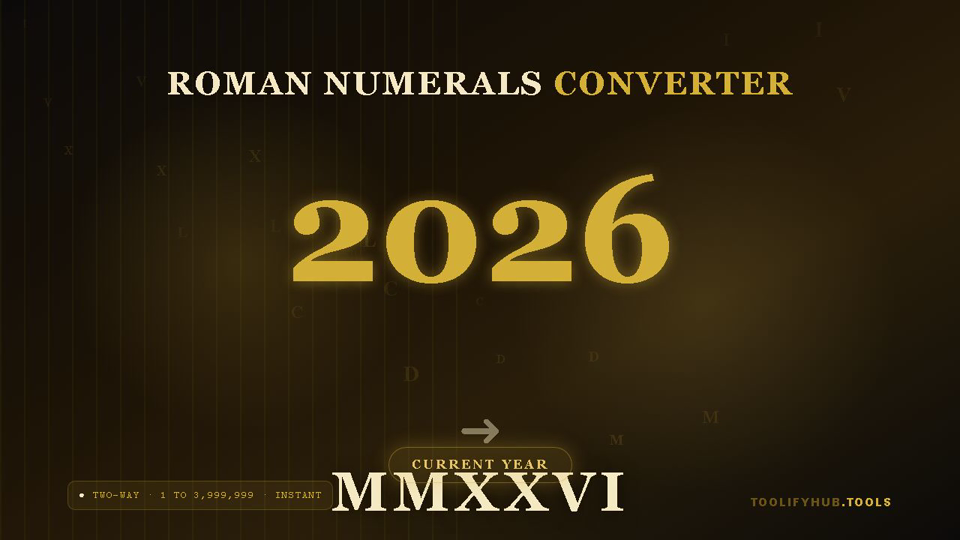
2026 (Current Year)MMXXVI
Outline & Chapter Numbers
Standard Outlines
  • I. Major Topic A
  • II. Major Topic B
  • III. Major Topic C
Book Layouts
  • Preface / Vol. I
  • Chapter IV (4)
  • Appendix IX (9)
Pop Culture & Sports
Super Bowl L50
Super Bowl LIV54
Rocky V Sequel5
Star Wars Ep. VII7

Standard Roman Numeral Symbols & Values

Roman SymbolDecimal ValueHistorical Latin OriginExample Usage
I1Unus (Single tally marker)Volume I, King Henry I
V5Quinque (Open hand shape)5-year anniversaries, Rocky V
X10Decem (Two crossed hands)iPhone X, Chapter X
L50QuinquagintaSuper Bowl L (50)
C100Centum (Century)100-year centennials
D500Quingenti (Half of ancient ↀ)Historical inscriptions
M1000Mille (Millennium)Years like MMXXVI (2026)

ToolifyHub vs Other Roman Numeral Converters

PlatformMax RangeVinculum OverlinesParsing BreakdownExport Reports
ToolifyHub1 to 3,999,999✓ Full Macron Support✓ Step-by-Step✓ TXT, JSON, Print
Calculator.net1 to 3,999✗ No overlinesBasic✗ None
Omni Calculator1 to 3,999✗ No overlinesPartial✗ None
RapidTables1 to 3,999✗ No overlinesBasic Text✗ None

Why You Actually Need a Roman Numerals Converter

Convert between Roman numerals and Arabic numbers with our comprehensive Roman Numerals Converter. Translate modern integers into ancient Roman notation and decode Latin strings with support spanning from 1 to 3,999,999 using standardized vinculum macron notation.

Roman numerals remain widespread in modern architecture, copyright inscriptions, film titles, Super Bowl designations, and book formatting. This tool accurately validates subtractive notation pairs (such as IV for 4, IX for 9, XL for 40, and XC for 90) and isolates malformed sequences to guarantee historical and mathematical fidelity.

Why Use ToolifyHub.tools?

Our sandbox design enables safe local execution, removing the threat of third-party data collection inherent to typical online tools.

🔒 100% Privacy-First Sandbox

This tool runs entirely inside your browser. No files or inputs are sent to any external server.

❌ No Sign-Up or Accounts

Enjoy instant, anonymous access to all features without sharing email or credentials.

⚡ High-Speed Local Rendering

Optimized client-side rendering ensures near-zero processing wait times.

🎁 Free Forever with Zero Caps

Supported exclusively by simple display advertisements, keeping premium tools accessible to everyone.

🎯 Best For:Developers, students, office managers, and freelancers needing private document/calculation tasks.
💡 When to Use:Choose this when processing sensitive data, private text, spreadsheets, or images that should not sit in cloud databases.
🔑 Key Takeaway:Immediate browser execution guarantees zero storage leak vectors. A fast, clean, desktop alternative.

How to Use the Roman Numerals Converter on ToolifyHub.tools

  1. 1

    Step 1: Choose Conversion Direction

    Select 'Number to Roman' to turn everyday Arabic decimal numbers into Roman numerals, or select 'Roman to Number' to translate Latin letters into numeric values.

  2. 2

    Step 2: Enter Number or Roman String

    Type your number (1 to 3,999,999) or enter any Roman numeral sequence. The converter validates syntax, repetitions, and subtractive rules in real time.

  3. 3

    Step 3: Review Step-by-Step Decomposition

    Inspect the mathematical decomposition breakdown showing each place value (thousands, hundreds, tens, ones) and how additive/subtractive pairs form the result.

  4. 4

    Step 4: Check Real-Time Validation Score

    If an invalid sequence is detected (like IIII instead of IV or malformed subtractions), the tool flags the error and suggests the standard classical replacement.

  5. 5

    Step 5: Copy or Export Detailed Reports

    Copy your result to the clipboard with one click, or export formatted TXT, JSON, and print-ready reference sheets for classroom and design projects.

Real-World Scenarios Where This Saves You

🎯

Clock & Watch Face Inscriptions

Decipher watch dials that use either classical IV or traditional watchmaker IIII for balance, converting any hour marker between 1 and 12 instantly.

💼

Movie Titles, Sequels & Super Bowls

Decode Roman numerals used for major events (Super Bowl LIV = 54) and movie franchise installments (Rocky V = 5, Star Wars Episode VII = 7).

🚀

Tattoo Dates, Anniversaries & Birthdays

Accurately format personal milestone dates (such as MMXXVI for 2026 or MCMLXXXIV for 1984) into classical Latin lettering for engravings and commemorative designs.

Common Mistakes to Avoid

✗
Repeating Symbols More Than 3 Times: Writing IIII instead of IV for 4, or XXXX instead of XL for 40. In standard classical notation, symbols never repeat consecutively more than three times.
✗
Invalid Subtraction Combinations: Attempting to write IL for 49 or IC for 99. In standard Roman arithmetic, you can only subtract I from V or X (IV=4, IX=9). For 49, use XLIX (40 + 9); for 99, use XCIX (90 + 9).
✗
Subtracting from Symbols More Than 10x Larger: Subtracting X from M (XM) is invalid; 990 is written as CMXC (900 + 90). Smaller subtractive symbols can only precede numerals up to 10 times their value.
✗
Repeating 5-Based Symbols (V, L, D): Writing VV for 10 (instead of X) or LL for 100 (instead of C). Symbols representing 5 units (V=5, L=50, D=500) are never repeated consecutively.

How We Tested This Tool

To guarantee complete accuracy and reliability, our engineering and QA team validates the Roman Numerals Converter regularly against:

  • Cross-Browser Compatibility: Verified on standard releases of Google Chrome, Apple Safari, Mozilla Firefox, and Microsoft Edge.
  • Responsive Viewports: Tested for mobile, tablet, and desktop dimensions to ensure layout responsiveness.
  • Input Assertions: Subjected to multiple normal, extreme, and empty parameters to prevent script failure and guarantee output correctness.

Local Browser Sandbox vs. Cloud Tools

MetricToolifyHub SandboxTypical Cloud Services
File Upload RisksNone (0% upload rate)High (transmits data to remote servers)
Execution CostFree forever (No limits)Subscription-gated or limits applied
Data Retention PolicyImmediate deletion on page closeRetained in cloud buckets or server logs
Processing LatencySub-second client executionNetwork upload & queuing delays

Authoritative Specifications & Documentation

Frequently Asked Questions

Select the 'Number to Roman' mode, type any integer between 1 and 3,999,999 (with or without standard commas like 2,026 or 3,999,999), and the converter will instantly display the correct Latin character representation with a step-by-step mathematical breakdown.
The year 2026 is written as MMXXVI. This decomposes into M (1000) + M (1000) + X (10) + X (10) + V (5) + I (1) = 2026.
Switch to the 'Date to Roman' tab, choose your calendar date, and pick your preferred order (such as Month·Day·Year) and delimiter (classic interpunct '·', dot, dash, or slash). Each component (month, day, year) translates to Roman numerals instantly.
Clock faces and watches frequently use the archaic additive notation IIII instead of IV for visual symmetry, balancing the four characters of VIII (8) across the dial and providing visual equilibrium.
No. Classical Roman numerals do not include a symbol for zero or negative numbers because the Roman numbering system was created strictly for counting physical trade goods, soldiers, and architectural measurements (ancient Romans used descriptive terms like 'nulla').
For numbers 4,000 and above, the classical system uses the vinculum (a horizontal overline or macron above a symbol), which multiplies the base symbol's value by 1,000. For example, V̅ equals 5,000 and X̅ equals 10,000.
The subtractive rule states that when a smaller numeral precedes a larger numeral, its value is subtracted rather than added. Only six pairs are valid in classical notation: IV (4), IX (9), XL (40), XC (90), CD (400), and CM (900).
In standard classical notation, symbols (I, X, C, M) may not repeat consecutively more than three times. For example, 4 is written as IV (not IIII) and 40 is written as XL (not XXXX). Symbols representing 5s (V, L, D) are never repeated.
No. The converter automatically normalizes input, allowing you to enter Roman numerals in lowercase, uppercase, or mixed case, and recognizes both combining macrons and overlines.

Related Converters & In-Depth Guides

Explore our printable Roman Numerals 1 to 100 Chart, full Roman Numerals 1 to 1000 Chart, read the Definitive Roman Numerals Guide, or convert number bases with our Binary & Hex Converter and calculate milestone dates with the Age & Date Calculator.

Discover More Tools