ToolifyHub.tools
Skip to main content

Pomodoro Timer

Direct Answer & Definition

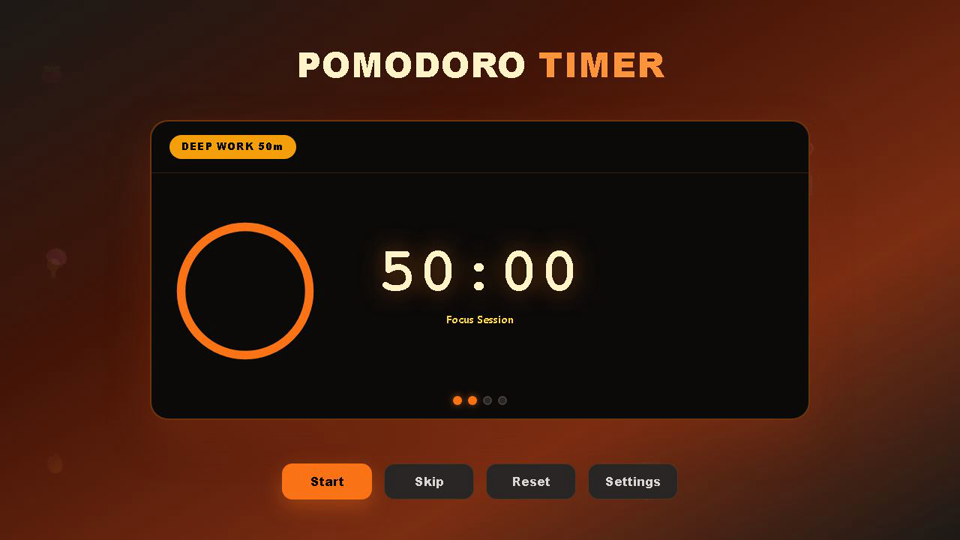
This free online Pomodoro Timer turns the classic time-blocking technique into a full productivity workstation. Switch directly between 25m Pomodoro, 50m Deep Work, 45m Exam Study, 90m Coding Sprint, and open-ended Flowtime modes. Features zero-drift timestamp synchronization across background tabs, ambient noise generator (rain, forest, white, brown noise), Screen Wake Lock API, interactive task checklist, scratchpad notes, dual GainNode volume controls, and a 14-day local activity heatmap. 100% private in your browser.

Stay focused and eliminate mental fatigue with customizable 25/5 and 50/10 intervals, ambient sounds, and zero background tab drift.

Read the step-by-step guide for Pomodoro Timer
Instant
Private
Free
Last Updated: July 2026|Reviewed by: ToolifyHub.tools Editorial Team|100% Browser-Based Security
Pomodoro timer: focus sessions demo
25:00
🎯 Focus Session
Specialized Work Presets
14-Day Local Focus Heatmap
01
02
03
04
05
06
07
08
09
10
11
12
13
14
Completed Sessions

0 / 8

Total Focus Time

0 mins

Rest Time Logged

0 mins

The Science Behind the Pomodoro

Attention naturally dips ~25-30 min

The 25-min block sits inside your golden attention window: long enough for deep work, short enough to dodge drift.

A deadline defeats procrastination

A ticking countdown converts abstract 'do the work' into a concrete finish line, reducing task-start anxiety.

Rhythm beats willpower

Boredom/fatigue dip at predictable intervals; planned rests pre-empty the crash instead of battle it.

Recovery is the multiplier

Sustained focus without breaks collapses after ~2 hours. Structured rest extends total productive output.

Which Preset Fits You?

StudentsExam Study 45m
Long-enough blocks for past-paper runs, calm break for recall consolidation
45m deep / 15m break
WritersPomodoro 25m
Low-pressure drafts; the break defuses the inner critic
25m draft / 5m line
DevelopersCoding Sprint 90m
Flagship intervals for flow-state feature work
90m build / 30m refactor
ResearchersReading 30m
Deep reading + digestion window before logging notes
30m source / 15m gut

The Classic 4-Cycle Rhythm

1
Pomodoro
25-min focus on one task
4
Pomodoros
Complete 4 focus blocks = 1 cycle
1
Long Break
15-30 min after every 4th block
8
Sessions
Common full-day target (~3.3h deep work)

Advanced Scheduling Patterns

Time-blocking a full day

Morning = 4 deep pomodoros, lunch, afternoon = 2-3 lighter ones. Track finish-time estimate to plan real work.

Flow-stacking sprint

Long 90m block first (flow work), then compress admin into 25m blocks. Save each as a preset.

CSV productivity log

Daily export gives you a focus/capped ratio across the week: spot the tired-pattern days and adjust.

Official Focus Intervals & Time-Blocking Guide

Select the optimal time-blocking interval calibrated to your cognitive task complexity and mental endurance:

Classic Pomodoro (25/5)

25m Work / 5m Rest. Best for beating task initiation resistance, administrative work, routine email triage, and student study sprints.

Deep Work Sprint (50/10)

50m Work / 10m Rest. Ideal for complex software development, academic paper drafting, and heavy analytical architecture.

Ultradian Cycle (90/20)

90m Work / 20m Rest. Aligned with natural human biological energy rhythms (Nathaniel Kleitman) for deep creative flow states.

Cognitive Science & Attentional Energy Management

Mitigating Attentional Fatigue

Continuous cognitive engagement depletes prefrontal cortex resources. Mandatory micro-breaks give your brain intervals to flush attentional residue, preserving high-level problem solving across multi-hour workdays.

Parkinson's Law & Time Urgency

Parkinson's Law dictates that work expands to fill the time available for its completion. By setting explicit, indivisible 25-minute boundaries, you establish gentle positive urgency that curtails scope creep.

Time-Blocking Interval Comparison Matrix

Compare standard Pomodoro intervals against Flowtime and Ultradian biological cycles to match your cognitive stamina:

Method PresetFocus DurationRecovery RestLong Rest CycleOptimal Cognitive Fit
Classic Pomodoro25 minutes5 minutes15-30m every 4thTask initiation, email triage, student flashcards
Deep Work Sprint50 minutes10 minutes20-30m every 3rdSoftware engineering, essay writing, data analysis
Exam Study Sprint45 minutes15 minutes30m every 3rdPast-paper simulations, memorization consolidation
Ultradian Rhythm90 minutes20 minutes45m lunch / walkDeep architecture, creative composition, research
Flowtime FrameworkOpen (Count-Up)1:5 ratio (min 2m)Natural fatigue cueADHD hyperfocus, spontaneous debugging flow

Core Concepts & Operational Definitions

Direct, factual explanations of foundational time-management principles:

The Pomodoro Technique

An empirical time-management framework created by Francesco Cirillo in the late 1980s. It partitions focused work into indivisible 25-minute intervals separated by 5-minute restorative breaks, followed by a 15-30 minute long rest after every four cycles.

The Flowtime Framework

An adaptive, open-ended focus system invented by Zoe Readhead. Rather than triggering rigid countdown alarms that interrupt immersive concentration, users start an open stopwatch and take a proportional rest break (1 minute of rest for every 5 minutes worked).

Parkinson's Law

The observation formulated by Cyril Northcote Parkinson in 1955 stating that "work expands to fill the time available for its completion." Establishing strict, indivisible 25-minute sprints creates positive urgency and prevents scope creep.

Attentional Residue

A cognitive psychology phenomenon identified by Dr. Sophie Leroy in 2009. Rapidly context-switching between uncompleted tasks leaves cognitive fragments stuck on prior tasks. Single-task time-blocking protects working memory bandwidth.

Mathematical Foundations & Timing Algorithms

Deterministic time-blocking formulas calibrated for metabolic energy budgeting:

Daily Focus Energy Budget
T_focus = N_sessions * 25m

Most knowledge workers sustainably achieve 4 to 8 high-quality sessions per day (100 to 200 minutes of pure deep focus), reserving remaining hours for recovery and asynchronous communication.

Flowtime Proportional Rest
T_break = max(2, round(T_flow / 5))

Dynamically calculates recovery duration based on exertion: 25 minutes of flow grants 5 minutes of rest; a 50-minute sprint yields 10 minutes; a 90-minute block yields 18 minutes of rest.

Zero-Drift Target Delta
T_rem = max(0, ceil((T_target - now) / 1000))

Calculates remaining countdown time against device hardware timestamps. Circumvents browser background tab timer throttling (Chromium/WebKit) via the W3C Page Visibility API.

ADHD & Executive Function Scaffolding

How visual interval timers assist individuals navigating executive dysfunction and time blindness:

Overcoming Task Initiation Resistance

Monolithic, open-ended tasks trigger dopamine-deficient avoidance. A 25-minute (or 10-minute micro-sprint) visual clock reduces perceived threat, transforming an overwhelming project into a low-stakes, manageable commitment.

Externalizing Time Perception (Time Blindness)

ADHD brains struggle with internal temporal estimation. Dynamic SVG progress rings, tab title countdowns, and distinct Web Audio acoustic cues make the passage of time concrete, physical, and predictable.

In-Depth Educational Guide

Mastering the Pomodoro Technique: Science, ADHD & Time-Blocking

Explore the complete neuroscience of attention, cognitive residue mitigation, overlearning protocols, and customized interval scheduling.

Read Free Guide

Why You Actually Need a Pomodoro Timer

Boost your daily output and protect your mental stamina with ToolifyHub's free online Pomodoro Timer workstation. Structured in 25-minute focused sprints followed by 5-minute restorative breaks, this platform turns time-blocking into an intuitive, distraction-free workflow.

Invented in the late 1980s by Francesco Cirillo, the Pomodoro Technique provides external cognitive scaffolding that reduces procrastination, sharpens working memory retention, and enforces healthy micro-recovery breaks. ToolifyHub enhances the classic physical tomato clock with zero-drift timestamp synchronization, Web Audio volume controls, Screen Wake Lock API, task checklists, and local 14-day habit heatmaps.

Why Use ToolifyHub.tools?

Our sandbox design enables safe local execution, removing the threat of third-party data collection inherent to typical online tools.

🔒 100% Privacy-First Sandbox

This tool runs entirely inside your browser. No files or inputs are sent to any external server.

❌ No Sign-Up or Accounts

Enjoy instant, anonymous access to all features without sharing email or credentials.

⚡ High-Speed Local Rendering

Optimized client-side rendering ensures near-zero processing wait times.

🎁 Free Forever with Zero Caps

Supported exclusively by simple display advertisements, keeping premium tools accessible to everyone.

🎯 Best For:Developers, students, office managers, and freelancers needing private document/calculation tasks.
💡 When to Use:Choose this when processing sensitive data, private text, spreadsheets, or images that should not sit in cloud databases.
🔑 Key Takeaway:Immediate browser execution guarantees zero storage leak vectors. A fast, clean, desktop alternative.

How to Use the Pomodoro Timer on ToolifyHub.tools

  1. 1

    1. Select a Single Primary Task

    Choose one specific task from your to-do list and enter it into the Session Tasks drawer. Committing to a single objective prevents context switching.

  2. 2

    2. Choose Your Focus Interval Preset

    Pick standard 25m Pomodoro, 50m Deep Work, 45m Exam Study, or 90m Ultradian Sprint according to your cognitive task complexity.

  3. 3

    3. Start the Countdown Clock

    Click Start Focus or press Space. Keep the timer open on your screen or minimize the tab: ToolifyHub displays real-time countdown progress directly in your browser tab title.

  4. 4

    4. Work Indivisibly Until the Chime

    Maintain focus until the alarm sounds. If a distracting thought arises, write it down in the Quick Notes scratchpad and return immediately to your task.

  5. 5

    5. Take a 5-Minute Physical Rest Break

    Step away from your monitor, hydrate, stretch, and relax your vision with the 20-20-20 rule to restore working memory capacity.

  6. 6

    6. Enjoy a 15-30 Minute Long Rest

    After completing four consecutive focus cycles, take an extended break to disconnect completely and recharge your energy.

Real-World Scenarios Where This Saves You

🎯

Software Engineering & Code Architecture

A developer tackling complex algorithm refactoring uses the 50/10 Deep Work preset. With ambient brown noise masking open-office banter, they write clean code with sustained attention and zero background timer drift.

💼

University Exam Revision & Cramming

A student studying for medical licensing exams uses 25/5 intervals to review dense pharmacology flashcards, checking off completed units and tracking their 8-session daily goal in the 14-day heatmap.

🚀

Article Drafting & Creative Writing

An author fighting procrastination commits to two 25-minute drafting blocks. Knowing they have an enforced break in 25 minutes bypasses perfectionist hesitation and produces 1,200 raw words.

🚀

ADHD Executive Function Scaffolding

An adult with ADHD uses the visual shrinking progress ring and clear session dots to make the abstract passage of time visually concrete, reducing task initiation friction.

Common Mistakes to Avoid

✗
Skipping Scheduled Rest Breaks: Working straight through breaks when feeling productive creates cognitive debt that leads to severe mental exhaustion and burnout by mid-afternoon.
✗
Allowing Digital Notifications to Interrupt Sprints: Checking incoming chats or email notifications during an active focus block shatters flow state, requiring up to 15 minutes to re-attain deep concentration.
✗
Setting Overly Ambitious Daily Goals: Attempting 14 to 16 pomodoros in a single day is unsustainable. Aim for 4 to 8 high-quality sessions (2-4 hours of true deep work) for consistent output.
✗
Treating the Timer as a Rigid Stress Source: If an urgent meeting or critical event occurs, pause or reset the timer calmly without guilt. The timer is a supportive tool, not a punitive scorecard.

How We Tested This Tool

To guarantee complete accuracy and reliability, our engineering and QA team validates the Pomodoro Timer regularly against:

  • Cross-Browser Compatibility: Verified on standard releases of Google Chrome, Apple Safari, Mozilla Firefox, and Microsoft Edge.
  • Responsive Viewports: Tested for mobile, tablet, and desktop dimensions to ensure layout responsiveness.
  • Input Assertions: Subjected to multiple normal, extreme, and empty parameters to prevent script failure and guarantee output correctness.

Local Browser Sandbox vs. Cloud Tools

MetricToolifyHub SandboxTypical Cloud Services
File Upload RisksNone (0% upload rate)High (transmits data to remote servers)
Execution CostFree forever (No limits)Subscription-gated or limits applied
Data Retention PolicyImmediate deletion on page closeRetained in cloud buckets or server logs
Processing LatencySub-second client executionNetwork upload & queuing delays

Authoritative Specifications & Documentation

Frequently Asked Questions

The Pomodoro Technique is a time-management methodology created in the late 1980s by Francesco Cirillo. It breaks work into focused, indivisible 25-minute sprints (called pomodoros) separated by mandatory 5-minute short breaks. After completing four consecutive cycles, you take an extended 15- to 30-minute restorative break to recharge cognitive energy.
Francesco Cirillo selected 25 minutes because it represents a balanced duration: long enough to make substantive progress on demanding cognitive work, but short enough to maintain peak attention without mental drift or physical fatigue.
Most web timers use naive setInterval decrement counters that browser engines (such as Chromium and Safari) aggressively throttle to once per minute when the tab is backgrounded. ToolifyHub calculates elapsed time strictly via timestamp deltas (Date.now() against a target end timestamp) and re-synchronizes instantly via the W3C Page Visibility API when you switch back.
Yes. In the Settings & Audio panel, you can adjust focus time (1-180 min), short break (1-60 min), long break (1-90 min), and change the number of cycles before a long break occurs (1-12 sessions).
Engage in physical and sensory micro-recovery: stand up, drink a glass of water, perform the 20-20-20 eye rest exercise (looking 20 feet away for 20 seconds), stretch your shoulders, or practice deep box breathing. Avoid checking social media or email, which triggers cognitive residue.
Flowtime is an alternative framework where you start an open-ended stopwatch and work as long as you remain naturally focused. When your concentration wanes, you stop the timer and take a proportional rest break (typically calculated as 1 minute of break for every 5 minutes of deep work).
Most knowledge workers and students complete 4 to 8 high-quality pomodoros (2 to 4 hours of pure deep work) per workday. Deep concentration is metabolically demanding; expecting to complete 16 full pomodoros daily usually leads to exhaustion.
Cirillo recommends the Inform, Negotiate, Schedule, Call Back protocol for external interruptions. If an internal tangent thought arises, write it in the Quick Notes scratchpad and immediately return to your primary task until the timer chime rings.
Practice overlearning: use the remaining minutes to review your work, catch potential errors, refactor code, improve formatting, or organize next steps. An active Pomodoro block is considered indivisible.
Yes, 100%. ToolifyHub executes entirely client-side in your browser. All tasks, notes, settings, and 14-day history metrics are stored locally in your browser localStorage API. Zero data is transmitted to remote servers.
Yes. When enabled in settings, the timer utilizes the W3C Screen Wake Lock API to prevent your desktop monitor or mobile device from going to sleep while a focus sprint is actively running.
You can press Space to Play/Pause, R to Reset, N to Skip to the next phase, F to toggle Fullscreen mode, S to open Settings, M to Mute/Unmute audio, and Esc to exit Fullscreen.
Continuous acoustic masking sounds (such as rainfall or low-frequency brown noise) help drown out sudden, distracting environmental noises (conversations, traffic, door slams) that frequently trigger attentional switches.
Yes. ToolifyHub features independent Web Audio GainNode volume sliders for both the session completion alarm (0-100%) and the ambient background noise generator (0-100%).
The heatmap logs your daily completed focus sessions and focus minutes directly to localStorage. It visually shades each day from dark slate (0 sessions) to deep blue and emerald green (target reached), helping you maintain consistency.
The 50/10 interval pairs a 50-minute intense work block with a 10-minute restorative break. It is favored by software engineers, writers, and researchers who require longer uninterrupted immersion to enter deep technical problem solving.
Based on sleep and physiological research by Nathaniel Kleitman, the human brain naturally cycles through 90-minute peaks of alertness followed by 20-minute troughs of cognitive recovery.
Yes. When you click Reset, ToolifyHub displays a 5-second recovery toast with an Undo button that restores your exact previous countdown time and session phase.
Yes. Once the page is loaded, the Web Audio synthesizers, timer calculations, and localStorage data run 100% locally without requiring internet connectivity.
For adults with ADHD, initiating large tasks can feel overwhelming due to executive function friction. A 25-minute (or 10-minute micro-sprint) visual countdown provides concrete external scaffolding, making task initiation less intimidating.

Related Productivity Tools & Workflows

Discover More Tools